
Your best clients own businesses. Bring them what nobody else has.
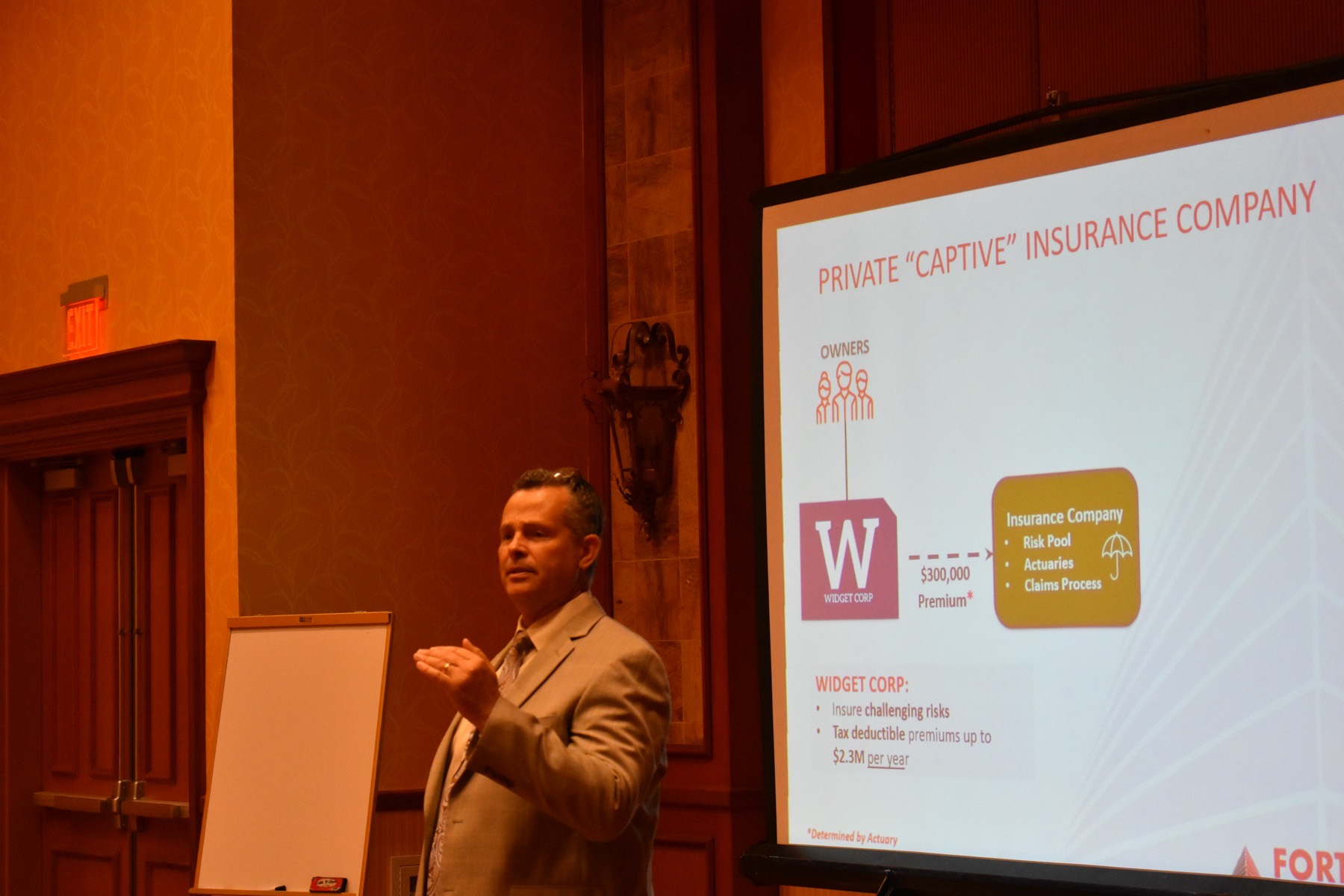
A captive is the one conversation that makes a business owner lean forward. It is also the one most advisors are afraid to start, because it looks complicated, it looks slow, and the firms that offer it tend to want your client for themselves. We built Fortress to fix all three.
It is complicated. It is slow. And somebody will try to take my client.
It is complicated.
It is a sequence. Assessment, formation, management. We teach the whole thing, free, and then we run it with you. You do not need to become an actuary. You need to recognize the client, start the conversation, and know what happens next. The certification gives you exactly that.
It is slow.
The actuary's study takes two or three weeks. Formation takes two to four. Your client watches every step on a board, and so do you. Slow is when nobody knows where things stand. That does not happen here.
Somebody will take my client.
Not us. Every certified advisor signs a non‑circumvention agreement with Fortress before they bring us a single name, and we sign it too. Your client stays yours, in writing, both directions.
And one you might not have thought of.
A captive builds reserves, and reserves have to be invested under written guidelines with a suitable advisor. For most of our clients, that advisor is the one who brought them to us.
Why your business‑owner clients need a captive, and why you should be the one who brings it.
Twenty minutes with the founder. How captives work, how advisors offer them today and where that goes wrong, and how Fortress does it differently. The advisor's playbook comes with it.
Certified Captive ConsultantTM Coming soon
Five sections, twenty-nine lessons, taught on video by the founder. Free. You finish with a credential, a listing in the public directory, and the tools to run a client through the process yourself.
- Video lessons with a two‑minute summary and a short check on each
- Five section exams and a capstone case you work start to finish
- A certificate and a badge you can add to your profile
- A listing in the Certified Consultant directory
- A quarterly live session with the founder
- Progress that saves, so you can work at your own pace
Section 1Fundamentals of captive insurance8 lessons
- Purpose of captive insurance: challenging risks, tax treatment of insurance profits, building loss reserves, profiting from your own risk
- Captives versus traditional insurance and self‑insurance
- Assessing risk: the actuarial study
- Why risk pooling and risk distribution matter
- Paying claims
- Selecting a domicile
- Annual administration
- Good industries for captive insurance
Section 2Feasibility5 lessons
- The initial consultation: Fortress, the advisor, and the client's objectives
- The business intake form and the documents to gather
- The engagement letter: scope, confidentiality, the one-time consulting fee
- Evaluating risks: reading the existing policies for gaps, and the actuary's questionnaire
- The actuarial study: what the report says and what it sets
Section 3Formation7 lessons
- Forming the reinsurance company: domicile, the corporate questionnaire, filings and elections, the subsidiary, capitalization
- Ownership of the captive and the rules that govern it
- The ancillary agreements the insurance manager prepares
- Paying premiums: frequency, flexibility, and premiums paid in advance
- Opening the accounts
- Investing premiums and reserves: liquidity, earned and unearned premium, the spectrum of choices, reporting
- The quarterly rhythm: cession statements and transfers
Section 4Function4 lessons
- Issuing the policy and establishing reserves
- Paying claims: the committee, the process, and when to claim
- Annual upkeep: the fee, the return and its election, financial statements, the license, minutes, the updated study
- Premium expense and how it steps down
Section 5Affiliating with Fortress5 lessons
- Respecting the advisor's client relationship
- The non‑circumvention and non‑disclosure agreement
- Investment accounts and bank accounts
- The role of the insurance manager
- Working with the client's accounting professionals
The back office. Everything you need to bring a client through.
The tools
Passed the course, listed in the directory, agreement signed.
- The fit check and the reserve illustration, in versions you run with your client
- The digital intake form and the document checklist
- The captive presentation, co-branded with your firm's mark
- Pre-approved emails, one-pagers, and the whitepaper
- Submit a client, and their board opens with you already on it
Your clients
You have brought a client through.
- Every board you are attached to, in one view
- Stage-change notifications by email and text
- The annual calendar for each captive
- The quarterly live session, recorded and kept
Co-marketing
You host events, and we show up.
- Seminar-in-a-box for your own events
- A principal at your event or on your webinar
- Fresh material for your study group, every time
What a certified advisor sees when they log in.
Every client, one screen.
Each client you have brought to Fortress appears with its current phase, the step it is on, and what is waiting on whom. Open any one to see the full board. You never have to call to ask where things stand.
Notifications you control.
Email and text when a stage changes on any client you are attached to. Mute the ones you do not need. Your client sees the same board, so you are never explaining a status you have not seen yourself.
One form. A board opens.
Name, company, what they do, what you know about their coverage. Submitting creates the engagement on our side, notifies a principal, and opens the client's portal board with you already invited to it.
Run the fit check and the illustration together.
The nine-question reading from the public site, and the reserve illustration that shows what premiums build when they stay with the business, both in a mode built for sitting next to your client. Their answers go straight into the intake. Neither tool is on the public site; what an advisor shows a client stays behind the login.
The captive presentation, ready to give.
The founder's own deck, rebuilt on the Fortress design system, with a slot for your firm's mark and speaker notes for every slide. Seminar-in-a-box if you host events.
Nothing you have to write yourself.
Email sequences, social posts, one-pagers, and the whitepaper, all pre-approved. Captive copy is sensitive. You should never have to draft it alone.
In writing, both directions.
The non-circumvention and non-disclosure agreement is signed electronically at certification. It says your client stays yours. It also says what you keep confidential about Fortress and its process. Both sides sign.
The economics, stated plainly.
What Fortress charges the client, how the captive's reserves are invested, and how that involves the client's own advisor. Reviewed by counsel, written for your compliance officer.